
Rethinking local government productivity
Whitehall is obsessed with efficiency drives. What’s missing is a serious strategy for public service reform.

I co-authored a report a fortnight ago with Joe Peck at The Productivity Institute on the role of local authorities and productivity.
In it, we argue that local government can play a much bigger role in tackling the UK’s long-standing productivity problem than has previously been acknowledged. Local authorities matter not only because they themselves can become more productive institutions, but because they shape many of the conditions that underpin economic growth — including housing, planning, skills, transport and public health.
Part of the reason government hasn’t grasped the nettle, I think, is that productivity in local government remains poorly understood. The Office for National Statistics currently measures productivity only in adult and children’s social care. The 2025 Public Service Productivity Review did not examine local government in detail because the now-disbanded Office for Local Government had been expected to develop this work further. The ONS is exploring the creation of an Environmental Services category to better capture local authority activity, which is a start, but there will continue to be a deficit in our understanding.
What we do know though is that the story has not been positive for quite some time.
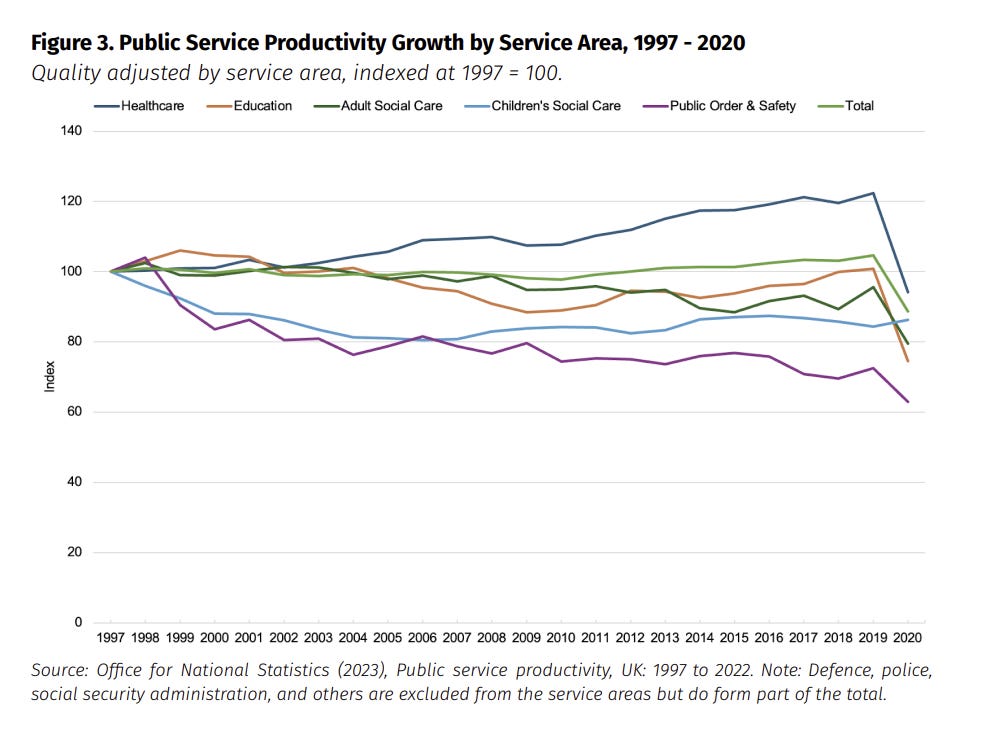
For too long, the dominant approach has consisted of episodic efficiency drives: narrow exercises focused on short-term savings rather than long-term reform. What is missing is a coherent, cross-government strategy for public service reform which includes local government.
Here, we echo concerns raised by the Institute for Government that, on the current trajectory, public services could emerge from this Parliament more centralised, less integrated and no more preventative than they are today.
We also echo the work of the Whitehall Public Sector Efficiency Group, which a decade ago captured the drivers of productivity (across all public services, but apply in equal measure to local government):
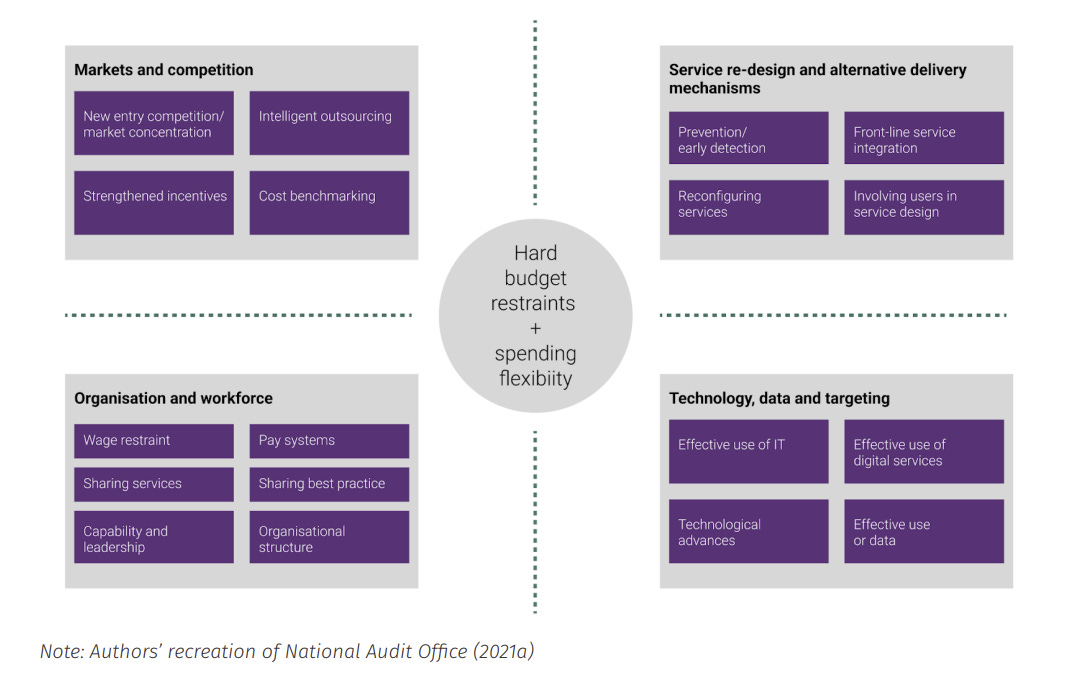
What is needed instead is a comprehensive reform programme aimed at improving local government productivity, rather than a menu of disconnected interventions. What we try and set out is to address distincts constraint on productivity, but their effectiveness depends on being pursued in parallel. The greatest gains will come not from isolated reform, but from their cumulative and reinforcing effects across the system.
First, we need better data and measurement. That can create the conditions for learning and accountability. We should also examine how we measure the performance of strategic authorities as a whole (the Integrated Settlements do some of this, though an Outcomes Framework has been created for each strategic authority to deliver against a specific set out outputs or outcomes across to the funding streams they’ve received in the Integrated Settlement).
Second, we need new tools for prevention and greater flexibility to innovate. Otherwise, better measurement risks simply creating more compliance rather than improvement. We recommend a Prevention Settlement for local authorities, drawing on the work of Demos (which argues for a PDEL, similar to the RDEL and CDEL) and others.
I am also drawn to the idea of re-creating the Power to Innovate, first used in schools in the 2000s. Too often, local government operates within a thicket of checks, balances and Secretary of State permissions that slow decision-making and discourage experimentation. If we want public services to improve, we need to create space for responsible policy innovation.
One example concerns the use of school land. Under the Education Act, school sites are tightly restricted to educational purposes. Yet some local authorities are experiencing significant falls in pupil numbers, leaving adjacent land underused. A Power to Innovate could give councils and schools greater flexibility to repurpose parts of these sites — for example, to support temporary accommodation provision at a time when homelessness has reached record levels in London and elsewhere.
Third, we need much more investment in capability and capacity-building. Here, the Office for Public Service Innovation offers a potentially scalable model that could be expanded across strategic authorities to provide analytical and decision-making capability to places, including local authorities. We also need sustained capital investment in genuine AI-enabled transformation. At present, much of what is described as AI reform sits at the margins — chatbots and minor automation tools that make services incrementally more efficient without redesigning them fundamentally.
Many advanced economies recognise this challenge institutionally. Countries including Denmark, Australia, New Zealand and the Netherlands operate Productivity Commissions or equivalent bodies that provide long-term strategic focus and independent scrutiny. Finally, we recommend the UK adopt a similar approach and establish a Productivity Commission. As work by The Productivity Institute has shown, these institutions can help sustain reform momentum across political cycles and create a clearer framework for evaluating what works.
None of this is a silver bullet. But without a broader strategy for public service reform — one grounded in productivity improvement, investment in capability, support for prevention and the enablement of innovation — we will continue to repeat the cycle of short-term efficiency drives that fail to deliver long-term or meaningful change.
Productivity as a sector or LA by LA basis?
Individual performance is a reflection of local priorities (and constraints). A nimby authority is never going to deliver lots of housing anymore than a cash starved authority is going to pump money into regeneration projects. Are they less productive than the aggregate, probably but if residents are happy does it matter?
Highways is a vastly important and expensive piece of local government that should be very susceptible to productivity analysis.