
LONDON’S BREXIT?
Questions have re-emerged about the size and shape of London after Reform UK suggested that Havering could stage a “Hexit” and Bromley could “Brexit” London.

Reform recently promised to hold a referendum on whether the London Borough of Havering should “exit London” if the party won control of the council. The idea echoes a long-running campaign by Andrew Rosindell, who defected from the Conservatives to Reform in January. Rosindell has argued for years that Havering was wrongly absorbed into Greater London in 1965, when Romford Borough Council and Hornchurch Urban District Council were merged to create the London Borough of Havering. He even tabled an amendment to the English Devolution and Community Empowerment Bill to that effect, though it was unsuccessful.
Havering is not the only borough Reform has targeted in this way. Reform has also suggested that Bromley should leave London too.
Could it actually happen?
The short answer is no. There is currently no legal mechanism by which a London borough can simply withdraw from London. Outside the capital, constituent authorities can leave strategic authorities, but only after a formal governance review, approval by the Secretary of State, and new secondary legislation. No equivalent route exists for London boroughs. For Havering or Bromley to leave London it would require primary legislation and a re-organisation of both London’s local government boundaries, as well as policing, transport, and other public services.
It is also unclear what ‘leaving London’ would actually mean. For Havering, the assumption is likely that it could become part of Essex. But for Bromley, it shares boundaries with Kent and Surrey: is Reform suggesting that it should be divided between them?
So why make the pledge?
In parts of outer London there remains a weaker sense of attachment to “London” as a civic or cultural identity than in the inner boroughs. In Havering, some residents feel they have more in common with Essex than with central London. Bromley presents a similar case, given its geography and longstanding suburban identity.
Data on belonging provokes some evidence of this divide, but it’s not particularly convincing. Feelings of belonging to London are weakest in Bexley and Bromley, where only 68 per cent say they feel they belong to the city. Since 2018–19, that sense of belonging has fallen by 12 percentage points across the authorities (the data is provided according to Assembly Member geographies, so we don’t have Bromley’s data on its own).
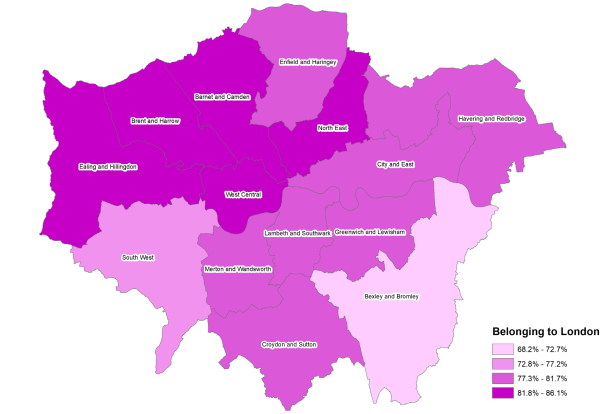
Though 68 per cent is clearly quite high, it does give Reform an opportunity to frame outer London authorities as neglected and culturally ignored by a London dominated by inner London political class.
What is more interesting, though, and the reason I wrote this Substack, is because it’s a reminder that London’s borders are political. London’s geography has always been contested and the idea that London’s current boundaries are natural or settled is ahistorical.
The boundaries of the London County Council, established in 1889, were inherited from the much older Metropolitan Board of Works, from 1855. Those lines had originally been drawn for public health administration rather than democratic government, and by 1889 they were already outdated. London’s population had doubled in the intervening decades.
The same debate resurfaced with the Herbert Commission – led by Sir Herbert Morrison, former Leader of London County Council and, er, Peter Mandelson’s grandfather – which reported in 1960. It laid the groundwork for the London Government Act 1963 and the creation of the Greater London Council in 1965.
At the time, the map could have looked very different. Places such as Epsom and Ewell, Cheshunt, Chorleywood and Watford were considered possible additions to London. Some strongly resisted. Epsom and Ewell argued that joining London would bring “no increased efficiency or economy or other public advantage”.
Here’s a snippet from Epsom and Ewell submission to the Herbert Commission:
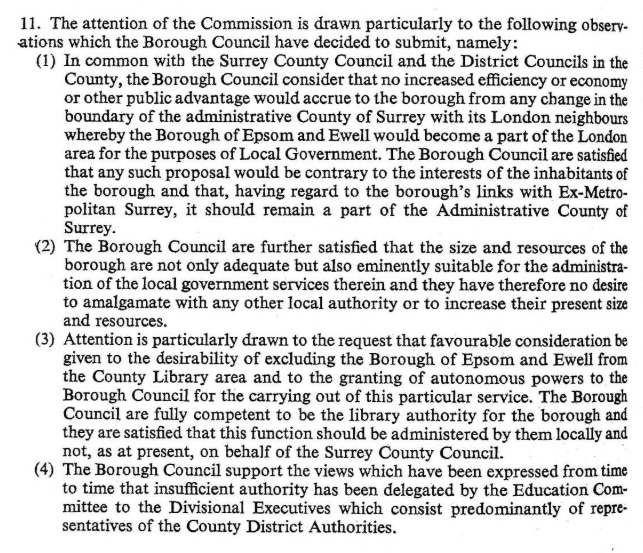
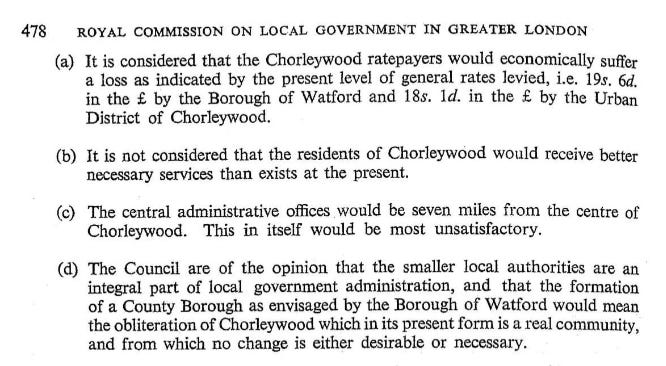
Cheshunt, meanwhile, complained that it had only been included because it fell within the Metropolitan Police geography. While Chorleywood warned that residents would pay higher taxes without better services. In other words, Havering’s Hexit and Bromley Brexit are not new at all. They are the latest version of a recurring question: where does London begin, where does it end, who should run public services?
Chorleywood’s submission to the Herbert Commission:
Reform’s implicit critique draws on similar themes. It performs strongest where there is dissatisfaction with mainstream politics, weaker attachment to institutions, and a sense that decisions are made elsewhere. Outer London boroughs such as Havering and Bromley fit that profile and tap into (at least some) resentment toward inner London, some of its residents at least hold suburban identities distinct from inner London, as well as a nostalgia for its history (which is only in living memory for those in their 80s).
Whether or not a London borough could ever leave London is almost beside the point. Reform’s campaign is really about persuading voters that London no longer works for them — and that Reform is the vehicle for saying so. It is a reminder a of perennial challenge for the capital: that its geography continues to be contested.
Interesting! I grew up in both Chorleywood and Watford and had no idea about this