
FORGET STATE CAPACITY: WHAT ABOUT LOCAL CAPACITY?
If Whitehall wants to address state capacity, it should look beyond Westminster

‘State capacity is the issue of our age’ according to the Economist. Judging by the attention Westminster is dedicating to it, the Economist is not wrong.
In the last fortnight, Darren Jones — Chief Secretary to the Prime Minister and de facto ‘enforcer’ charged with accelerating the Government’s agenda — has set out a plan to tackle the ‘sludge’ of the state. Jones is putting Whitehall on a war-footing.
The Attorney General is now reviewing requirements for consultations — which have received particular criticism in slowing down the planning regime (some unpublished Freedom of Information analysis I did some time ago revealed that one of the statutory planning consultees was staffed by volunteers, which is oxymoronic).
Top-performing civil servants are in line for better bonuses and poor performing ones will be shown the door (Jones observed that only two of the 6,700 senior civil servants were sacked for poor performance in 2025).
Reviews have been launched of government spending on homelessness, youth provision, the maintenance of public assets and health (social care, mental health and local services). The Government has already identified technical efficiencies to the tune of £14 billion by 2028-29 (according to Spending Review 2025) and a further £2.8 billion (according to Budget 2025).
Take the savings with a bucket of salt if you will, but few will disagree that Whitehall is far too slow and procedural. It can be more productive. And given its role in creating the conditions — legislation, policy, guidance — action in Whitehall can have a multiplier effect as those changes take place like a ripple effect in institutions across the country.
Yet if the Government also wants 2026 to be the ‘year of proof’, it will need to pay attention to more than Westminster. The Department for More Grip will not solve intractable challenges that Whitehall has only partial responsibility toward or control over.
Instead, more attention is needed on building local capacity. Jones has articulated a renewed commitment to “investment over cuts”, and to date the Government has taken proactive steps to, for example, increase the number of planners in local authorities (by 300 it should be said; which is welcome but insufficient) and provide local authorities with more funding certainty, yet redundancies are expected to continue as authorities balance their budgets. There has, in short, not been a meaningful increase in local authority capacity.
The Office for National Statistics highlights this most clearly, with central government capacity overtaking local government capacity in 2011. The gap has widened ever since.
Figure I. Headcount in central government overtook local government in 2011 and the gap has widened since
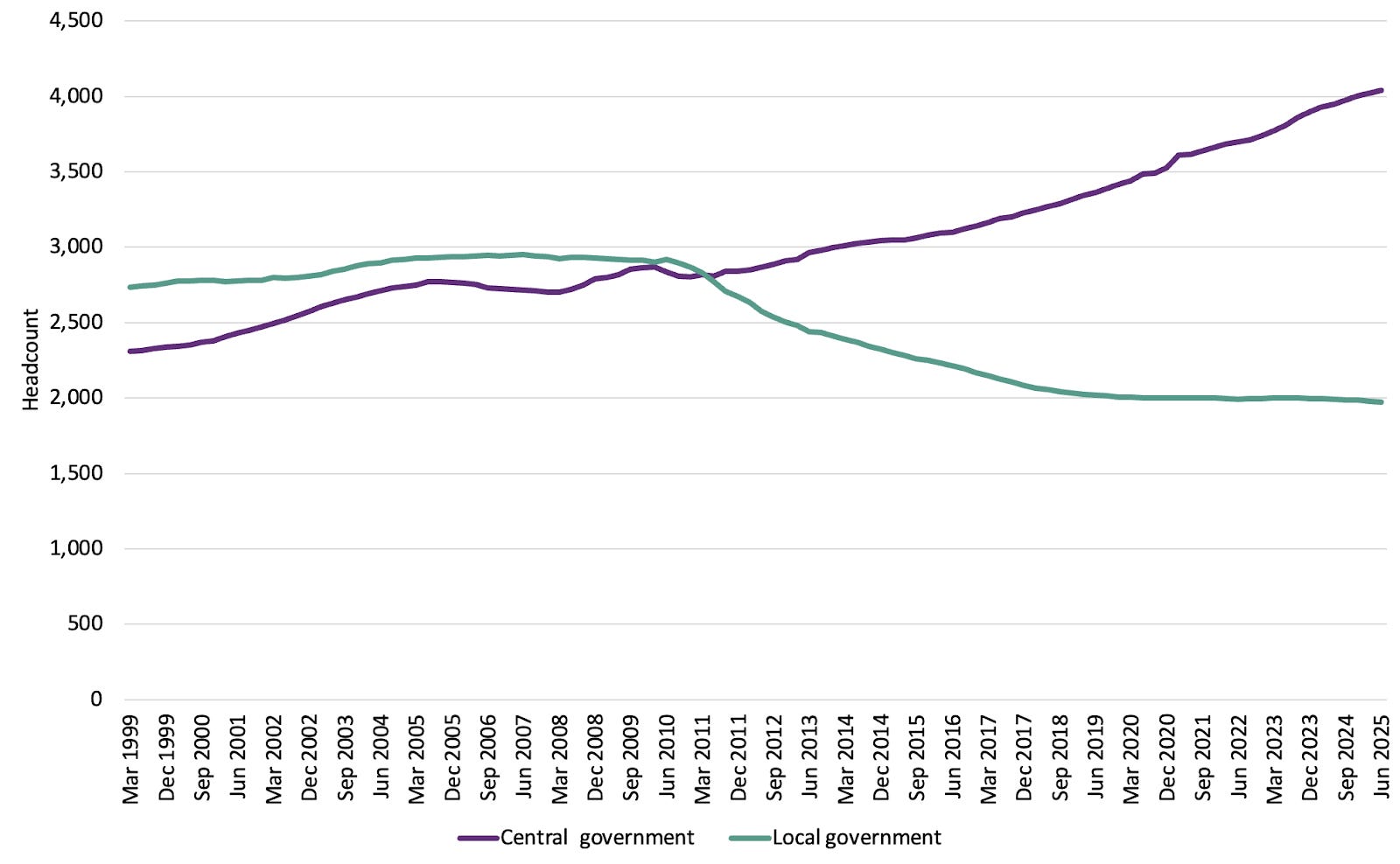
Source: Office for National Statistics, Public sector employment by sector classification.
That change has serious implications not just for communities, but for Whitehall too, which has had to disclaim its Whole of Government Accounts for two years because it does not have assurance in local authorities (The Coalition Government’s decision to scrap the Audit Commission has had a long-term, adverse impact on the audit market).
Addressing the capacity and capability constraints in local authorities that critically undermine public service delivery would, therefore, help this government deliver the change it seeks.
The suggestions I outline in this column are not intended to address longstanding capacity and capability constraints in their entirety, but they are low-cost and could be implemented in the short-term. So, what action might the Government take?
Give civil servants a stake outside of Whitehall
One challenge in local authorities is their ability to pause and reflect. Leadership teams are inundated with fires they need to put out. They will be navigating an ever-changing policy landscape, defending legal challenges across a whole range of services, be subject to inspection regimes, have ever-more complex subsidiaries to manage, will be exercising place leadership, managing their deficits, responding to genuine crises - fires, serious crime, riots - as part of Gold Command (or Silver or Bronze) and engaging in organisation-wide transformation programmes to prevent temporary accommodation or special educational needs (SEND) forcing them into bankruptcy.
In many cases, they simply need more social workers or more officers engaged in preventative activity in their Housing Options Team or Family Hubs. But they also need officials capable of developing and improving how they function and policy generalists are, unlike in Whitehall, in short supply.
The Civil Service Fast Stream’s model of rotating new entrants around departments every six months could help plug this capacity constraint. As a first step, the Fast Stream should require a six month rotation in a strategic or local authority. Though many civil servants engaged in policy-making are based in London, many should expect to work outside of London for the period.
With approximately 1,000 new fast streamers annually, this could create the equivalent of 500 of them full-time to support capacity. It will not only be good for local authorities, but it’ll also give the Civil Service a better understanding of how places function, how services are delivered and how to operate in a multi-disciplinary environment - a skill less common in Whitehall’s siloed and hierarchical system.
Make Local Government Attractive (MALGA)?
The public perception of local government is that it is uneventful and responsible for bushes, bins and bogs. That perception is also common in Whitehall. But it is wrong; authorities are at the coalface of frontier challenges: AI, climate resilience, demographic change.
I am less certain about how we navigate this challenge. I’m skeptical of national campaigns to promote the sector as I routinely hear mooted. Encouraging civil servants to transition to strategic and local authorities through, for example, advertising their roles on Civil Service Jobs, may be valuable. But that is marginal.
Attraction is also a distinct challenge for local authorities; strategic authorities have already become attractive to civil servants and many have made the transition (not least because their salaries are higher than local authorities). The creation of unitary authorities, operating across larger geographies, with bigger budgets and responsible for delivering more services, may be a more attractive proposition to many.
It is clear though that we also need a appetite for attracting ‘weirdos and misfits’ to think about the services local authorities deliver in a different way, and to make it attractive for them in the first place. I am not offended by the idea of standing up cohorts of experts joining local authorities for a time-limited period to support them with their thorniest challenges. But rather than civil servants, we need experts in behavioural science, artificial intelligence and organisational behaviour with experience of public services. I know many devout localists will disagree.
Consider the implications of devolution on the Civil Service
Third, the Government should consider the implications of devolution on the Civil Service. The idea that governing has become more complex has been a defence for retaining a higher baseline of civil servants post-Brexit. But what are the circumstances in which fewer civil servants are required?
When competencies are devolved to strategic or local authorities, should the Government undertake an assessment of Whitehall’s capacity and capability? Do you need as many civil servants in each department in a mature devolved landscape?
The answer may be yes. And I appreciate that turkey’s don’t vote for Christmas so it might create perverse incentives for devolution (why might a civil servant be enthusiastic about devolution if it meant their role could be surplus to requirements), but it is a theme that has not to date been explored.
Co-locate civil servants and local officials
The Conservative administrations highly prized moving civil servants to sites outside of London. They described it as a strategy to boost regional economic growth — which I think a weak rationale. Under the Places for Growth programme relocating 1,000 civil servants reportedly generates £30 million in benefits to the places they move. The current government have similarly encouraged civil servants to move out of London (which it says will generate £729 million in local benefits between 2024 and 2030) but its focus has been much more on challenging the so-called group-think of Whitehall and to “deliver and develop government policy closer to the communities it affects”.
With local authorities increasingly reviewing and disposing of their assets and some authorities (such as Kent) even looking to dispose of their town halls, could placing civil servants in authorities save them? Until recently Kent planned to sell its Grade-II County Hall, built in 1824 and designed by Sir Robert Smirke, the architect behind the façade of the British Museum. It would make Victorians that built town halls and civic pride weep that we can no longer maintain them. (Reform has cancelled the decision to sell, but a debate has ensued about the costs of doing so, given the maintenance it needs).
There are also likely to be other benefits beyond saving the heritage of places. Through the emergence of informal networks, would close collaboration, in the same office, also generate new insight and knowledge-exchange benefits, including public service innovation?
Bridge the gap between the policy and university ecosystems
Universities face a moral and economic crisis. They are better networked internationally than ever, but their local impact has never come under such scrutiny. Partly in response to this challenge, many universities have established vehicles to support policy-making in places.
As part of their London Local Authority Policy Fellowships, UCL academics are working in authorities including Camden, Islington and Newham to support their priorities. They are evaluating health messaging to improve health literacy and supporting authorities’ transition toward digitally and AI-enabled services.
Institutions have been created charged with bridging the policy-academic gap. The Productivity Institute (University of Manchester), Mile End Institute (Queen Mary University), Bennett School for Public Policy (Cambridge) and City-REDI (Birmingham), to name but a few. I am biased because I have worked with each of them at one time or another.
Similar initiatives such as Universities Policy Engagement Network and Capabilities in Academic Policy Engagement have been established.
So there is a lot of appetite among universities to support the communities they serve. But how do we build on these initiatives? I think we need to create the infrastructure to embed university expertise in places systematically and align it with the challenges facing local authorities. The Government funds this activity via UKRI, Research England, Economic and Social Research Council and others, but can it play a more muscular role in sponsoring it?
And how universities can also support places warrants more attention. It is not only through expertise, but their assets and their soft power can also be invaluable.
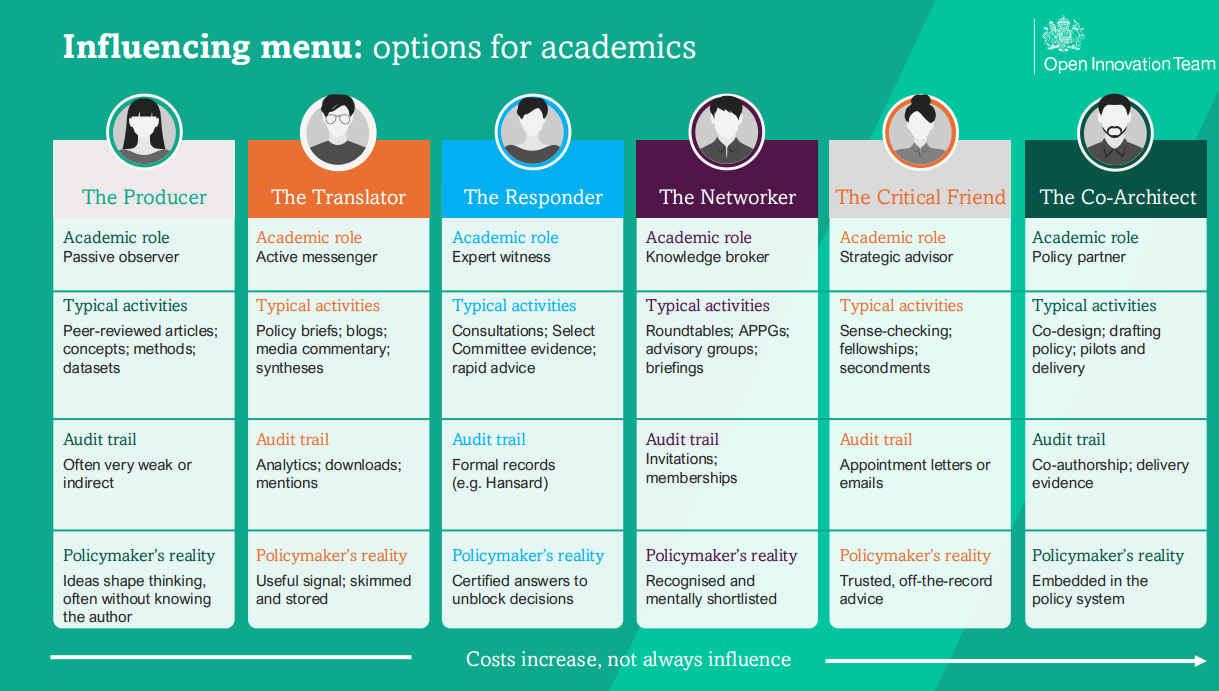
As a final thought, the Open Innovation Team created a ‘influencing menu’ for academics engaging with Whitehall. What is the influencing menu for universities in the places they are situated, and in supporting local authorities?
Great article (and some very stark data) and really interesting on ideas of greater integration between Whitehall and town halls to address capacity. Also really pleased to see the reference to the role of universities - so much more that could be done here to unlock capacity and assets, if only we can overcome some of the structural barriers (and not unrelated to the need to make local government sexy again). I'd love to see funding frameworks more explicitly acknowledge university's contribution to their local council in terms of providing academic expertise (as opposed to more transactional interactions).
The point about co-location seems good but what would it mean in practice ? There’s a reason civil servants throng around the Palace of Westminster, they want to be near power. What I fear would happen is lots of EOs and HEOs will sent off to the provinces whilst the SCS stays in Whitehall. Overtime this might bring fresh thinking in as they rise up the ranks, but the disconnect between decision and delivery remains unchanged.