
Devolution Revolution: The ‘Ideas Bank’ III
A live collection of practical ideas to push power out of Whitehall and into places — from governance reform to transport and regeneration.

Welcome back. Lets get it out of the way: I am a terrible Substacker and haven’t kept up with posting. I’ve been on the fence about Substack, but I’ve also had some kind comments about this series and other posts from unexpected places, so I should keep at it. It’s nice to know that what I write is getting read, so thank you for taking the time to read and engage.
Now, we’re back with the third installment of the Ideas Bank. I promise I won’t leave it this long until the fourth. You can read the first and second here. Without further ado:
A new devolution ‘growth package’ to support international growth
I co-authored a report with colleagues at City-REDI, which we published this week as part of the Commission on Devolution and Diplomacy.
Our argument is that the world has changed, and we need to change with it. That while Whitehall is doing lots of good work, we could do more to capitalise on the soft power of mayors on the international stage. This is an exciting opportunity and if we don’t grasp it enthusiastically we are leaving influence and investment on the table.
We articulate what we describe as a national framework for approaching the opportunity of international engagement. We call it sub-national diplomacy. It is very common in Australia, the United States, Japan and so on. You should read the report.
There are lots of recommendations we make relevant to this Substack, but I’ll pick one: the Government should develop a ‘growth package’ of devolution to support international growth. Investors want to know that they have access to good skills pipelines, which means giving mayors more power over skills devolution. Investors are more likely to engage with places that are convenient to get to, which means more direct flights (and we’ve seen Tees Valley, the Welsh Government and South Yorkshire subsidise them). We also know that domestic SMEs with export potential need business support, and there are funding streams across Whitehall that could be in the Integrated Settlement to support that activity. The precise contours of that ‘growth package’ would need more definition, but you get the idea.
Establish a new competency for international growth
There is much ground we couldn’t cover in the Commission, but one thing I think worth examining further is whether mayors should have an explicit competency for international growth.
At this point I remind readers that the purpose of this series is to surface devolution ideas; not all of them I agree with.
The case for this competency is that having one is a surefire way of securing funding from the Integrated Settlement. And it gives legitimacy to the activity, which is contested in some quarters.
States and provinces in Japan, Canada, United States and Australia are routinely, and aggressively, engaged in international activity. Lots of the US states are putting boots on the ground in the UK to poach our jobs, businesses and investment. Texas did so only in April. We should do the same. An explicit acknowledgement of this activity through the evolving competencies of strategic authorities would be one way to start.
The reason against the idea is that it’s superfluous; mayors have a competency for growth already and that is broadly defined. It does not rule out international engagement or growth.
Give mayors a formal say in Trade Deals?
Sticking with the international theme for a moment: while the federal government negotiates treaties in Canada, it cannot unilaterally implement them. Provinces must pass their own legislation to make international trade rules apply within their borders.
I don’t think we’re anywhere near that stage in English devolution, but I often return to this paragraph in the West Midlands’ Deeper Devolution deal:
Maximise the opportunity for WMCA, businesses and stakeholders within the WMCA area to contribute to national policy consultations, including the development of new free trade agreements, for example by responding to Calls for Input that inform the mandate for free trade agreements.
I think its inclusion is at least curious. Without stymying the Government’s ability to negotiate trade deals, of course, should the Government give consideration to whether it can go further?
Establish a Terms of Reference for the Mayoral Council
Now, off the theme of international trade.
The Council of Nations and Regions has a Terms of Reference. The Mayoral Council does not at least as far as I’m aware.
Many have suggested that putting both of these on a statutory footing is worthwhile. It embeds them in the UK constitutional settlement. But with the passing of the English Devolution and Community Empowerment Act, that is now implausible.
However, the Government should at least establish a Terms of Reference for the Mayoral Council, if it doesn’t already exist. If it does exist, publish it.
It was put to me this week that this embeddedness helps manage relationships and prevent instances such as the Mayor of Greater Lincolnshire ‘storming out’ of a meeting. Jenkyns told the Guardian she did not storm out but left 15 minutes early because “I am not a person who can sit around and listen to hypocrisy”.
Nevertheless, I can see the merit of a Terms of Reference, even if I am skeptical that it would radically change the relationship between Mayors and government.
Whether or not a much more substantive architecture akin to that which supports inter-governmental relations (of which a Terms of Reference would be part of) is worthwhile to service mayors is a much more interesting question, I think.
Resource the BBC to hold combined authorities to account
Patrick Diamond, Andy Westwood and I submitted evidence to the Lords Economic Affairs Committee’s inquiry on fiscal devolution last week. When I was exploring accountability arrangements using the Bennett School’s four modes of accountability I was surprised to learn, with the exception of the Greater London Authority, each strategic authority is scrutinised by less than one full-time equivalent Local Democracy Reporter (because they cover local authorities too).
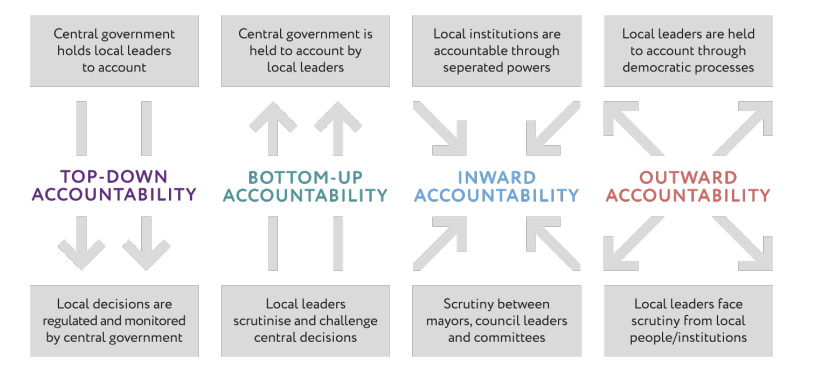
The Government is putting £13 billion into the Integrated Settlement. I think a few dozen LDRs would help improve value for money by providing stronger accountability arrangements.
Rural proof strategic authorities
The Campaign to Protect Rural recommended last week that the Government should, as you might expect, rural-proof strategic authorities.
What does that mean? Well, I struggle to know exactly whether strategic authorities should have different devolved competencies if they are in predominantly rural or semi-urban constituencies, or what those might be. Or should there be institutional divergence between urban and rural strategic authorities? Or, alternatively, should the powers and institutions be the same (according to their respective tiers in the Devolution Framework) and instead we leave places to focus on their respective areas of interest as they please?
Someone should answer those questions, and it won’t be me in this Substack, but a few reflections.
The English Devolution and Community Empowerment Act gave strategic authorities a new competency for rural affairs. Among other things, it’ll give Mayors more autonomy to, for example, appoint a Rural Affairs Commissioner in the same way you might appoint a Transport Commissioner.
As Foundation Strategic Authorities are created though, and as many of them will be in polycentric sub-regions or rural sub-regions, there is a particular value in examining whether the FSAs are the default model for strategic authorities that are principally rural. Those areas have tended to be less enthusiastic about a mayoral-led combined authority, so there’s alignment there at least.
Localis has similarly called for a “clearer framework for non-mayoral authorities”.
More Investment Zones, please?
I am looking forward to writing an article with Bradley Ward and Darcy Luke building on the theme of zonification. It is an argument I first advanced at The Productivity Institute and while Quinn Slobodian in particular has written a good book called Crack-up Capitalism where he looks at this in detail, I think I have coined the phrase as a distinct policy response in regional economic policy-making. It’s entirely plausible I didn’t, but I’m just going to take credit for this one.
So, I was interested to see Polly Billington MP in Renewal put forward a new special economic zone for coastal areas. You might say the same for rural areas too, and as I’d suggested in a previous Substack, high street zones?
Build on the Devolution Framework
The Government should revisit the Devolution Framework. It has clearly not had longevity and the Government should lay the groundwork now to explore the next iteration.
There are three important rationales, I think. First, it now needs to better account for the new competencies combined authorities possess. Second, too many departments have managed to get away with providing very little. And third, it did not anticipate fiscal devolution.
Put money behind the Foundation Strategic Authorities
There is a important question about the purposes of Foundation Strategic Authorities. Park that for now, and lets instead consider their finances. My understanding is that one of the reasons for Whitehall’s appetite for FSAs is because MHCLG is running out of cash for the Investment Fund. Readers, please correct me if I’m wrong.
Yet the idea of creating a FSA with no money is unattractive, at least locally.
So I’d like to moot the idea of an ‘Investment Fund’ lite, which could exist for a much shorter period, such as five years rather than 30, to be made available to non-mayoral FSAs.
Give local authorities the ability to compel academies to admit children
Finally, number 10. The caveat is that the Government has actually already placed a duty on schools, including academies, to co-operate with local authorities on school admissions and place planning as part of the Children’s Wellbeing and Schools Act, it assed me by and it might’ve passed you by too.
The story is simple. Academies make up 52 per cent of the 20,200 state-funded mainstream schools, according to the National Audit Office.
Local authorities are responsible for school-place planning, but until April there has been no duty on local authorities, multi-academy trusts or their schools to work together.
This was widely perceived as an issue by local authorities:
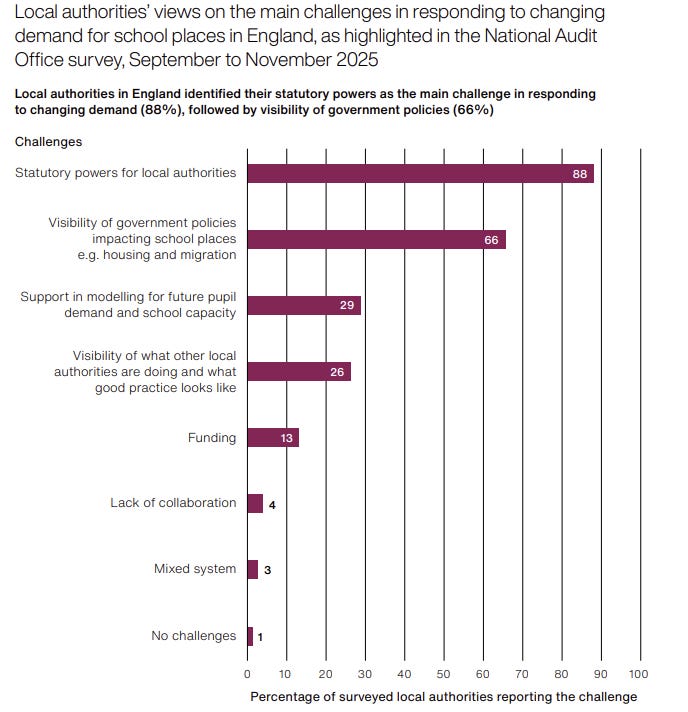
Great news that the Government has taken action on it. It will now be interesting to see how it works in practice.
That’s it for this Substack. Once again, ten(ish) random(ish) opportunities for devolution! More in the next post. Please subscribe if you enjoyed it: