
Devolution Revolution: Ideas Bank IV
A live collection of practical ideas to push power out of Whitehall and into places — from the Integrated Settlement to health inequalities.

I’m back with another edition of the Ideas Bank: a growing collection of practical ideas on how we can make English devolution more ambitious, effective and consequential.
I have been slow to write on Substack as Groundwork is publishing three reports in three weeks, but perhaps an incoming administration is in the hunt for options to extend devolution! Without further ado:
1. Make mayors statutory consultees
I am broadly sympathetic to reducing the number of statutory consultees in the planning system. Over time, the regime has accumulated a growing number of competing objectives, making decision-making slower, more complex and more vulnerable to delay. The Ministry of Housing, Communities and Local Government has revisited the issue on several occasions. Eighteen months ago, I submitted a series of Freedom of Information requests to statutory consultees and found that one organisation, albeit a relatively small one, relied heavily on volunteers to discharge its statutory responsibilities. There is something contradictory about a statutory process depending on goodwill rather than institutional capacity.
Despite that scepticism, there is a stronger case for granting elected mayors statutory consultee status. Doing so would further entrench devolution within the machinery of government. Rather than relying on convention or ministerial discretion, strategic authorities would acquire a legal right to be consulted on decisions that materially affect their powers, funding or governance.
The proposal would also strengthen accountability. Local authorities have demonstrated a willingness to challenge central government through the courts, as the current litigation over local government reorganisation illustrates. By contrast, strategic authorities have comparatively few formal mechanisms to compel government to engage with them. Statutory consultee status would provide mayors with a clearer legal basis to challenge procedural failures where government has not complied with its consultation duties.
There is a useful precedent. The Transport Action Network successfully challenged the Treasury’s 2023 decision to cut England’s active travel budget after the UK Court of Appeal held that ministers had acted unlawfully by failing to comply with statutory duties under the Infrastructure Act 2015. The case demonstrated that statutory consultation creates enforceable obligations. Extending similar protections to strategic authorities would help ensure that devolution is respected not just politically, but legally.
That said, the proposal should not be adopted uncritically. Would it unnecessarily gum up decision-making? Could it foster a more adversarial relationship between central and local government? There is also the important question of scope: precisely which decisions should require mayors to be consulted as statutory consultees?
2. Reform the Integrated Settlement
Over the last six-weeks, the Local Government Information Unit has published a three-part series I wrote on the Integrated Settlement. You can read Part I, II and III.
Two themes emerged consistently from our conversations. First, the Integrated Settlement is proving to be less flexible in practice than many had anticipated. While combined authorities are clear that it has encouraged a more strategic approach — focusing on outcomes rather than simply managing programme outputs — the scope to, for example, move funding between priorities remains constrained. There are other constraints on flexibility. Second, the accountability regime is widely seen as overly prescriptive, with Whitehall retaining significant oversight.
The more fundamental question, however, is whether the Integrated Settlement is itself a transitional model. If so, it would represent something of an indictment of the incrementalism that has characterised English devolution. Originally conceived as the Single Settlement and under development since 2023, the model risks becoming a stepping stone. Rachel Reeves’ Mais Lecture hinted at the possibility of assigning a share of Income Tax to mayoral strategic authorities, raising the prospect that the Integrated Settlement could ultimately be superseded before it matures. Equally, with the Overton window on English devolution shifting rapidly in recent weeks, there may now be political space for a more ambitious fiscal settlement than was conceivable even a few months ago.
3. Require strategic authorities to develop a health inequalities strategy
The Centre for Local Economic Strategies and the King’s Fund recommend that, now that strategic authorities have a duty to tackle health inequalities, they should be required to develop a health inequalities strategy.
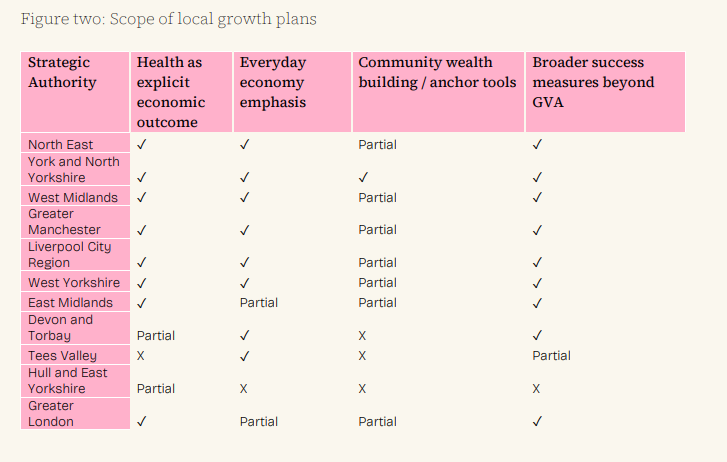
I recommended last month with my co-authors as part of the Commission on Devolution and Diplomacy that strategic authorities should be responsible for developing International Strategies (as Greater Manchester and the West Midlands have) so I am sympathetic to recommendations to design or publish strategies. I also share the concern that strategic authorities can get bogged down in strategy-setting. What is clear from their research though is that a focus on health inequalities, while embedded in most local growth plans, is not universal. That strengthens the case for the strategy they recommend.
Place the 464 Business Growth Advisors in strategic authorities
In his speech last month, Andy Burnham committed to devolving business support and argued that civil servants have an important role to play in helping strategic and local authorities build the institutional capacity and capability needed to exercise greater responsibility.
Yet despite the Government’s commitment in its Small Business Plan to simplify provision through integrated, locally led Growth Hubs, significant funding, expertise and delivery capacity remain concentrated in Whitehall.
One tangible option available to Andy Burnham is devolving the £42 million programme employing 464 Business Growth Advisors in 2024-25 and serving 10,000 employers, delivered through Innovate UK Business Growth. The current programme already posed questions about disparities in regional coverage. Here’s the Business Growth Advisors per region, according to a Written Statement:
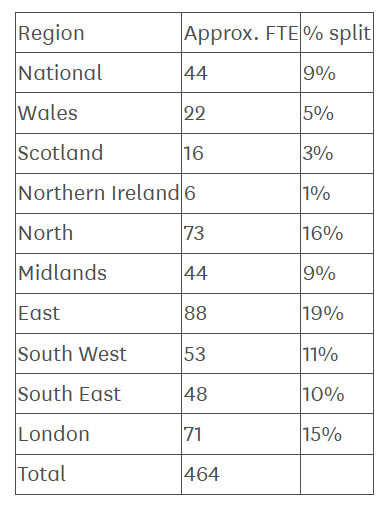
In areas such as South Yorkshire, where export performance remains below the national average and inward investment has been inconsistent, more integrated and locally controlled business support could play a critical role in, for example, building internationally competitive clusters and attracting Foreign Direct Investment.
5. Control over public utilities: what about airports?
Local authorities used to own more airports, but after Margaret Thatcher’s Airport Act in 1986, many of them sold their shares. Manchester Airport Group, part-owned by Greater Manchester local authorities, has done well out of airport ownership. Should local authorities or indeed strategic authorities own airports?
We have seen mayors occupy similar spaces recently, inc;uding promoting direct flight connections and tourism, specifically through subsidising flights. I think it’s a tool that is underdeveloped, although it has been used in Wales, South Yorkshire and Tees Valley already. The Welsh Government was taken to court over subsidy control concerns, but it won the legal battle.
6. Index strategic authorities’ Investment Funds to inflation
Does what it says on the tin. Every strategic authority receives an Investment Fund, but because it is not indexed to inflation, its real-terms value declines year after year.
7. Standardise the voting system in strategic authorities
The English Devolution and Community Empowerment Act has standardised some aspects of governance, introducing a simple majority as the default voting rule while requiring a two-thirds majority for decisions such as approving the mayoral budget. Yet it stopped short of establishing a coherent principle for the allocation of votes between constituent authorities.
The result is a patchwork of arrangements. In Devon and Torbay Combined County Authority, each constituent council holds three votes, despite Devon representing more than 800,000 residents and Torbay fewer than 150,000. Similarly, in York and North Yorkshire and the East Midlands, each constituent authority is allocated two votes irrespective of population. While it is politically understandable that no constituent authority would willingly accept fewer votes than its neighbours, the current model produces clear disparities in democratic representation.
The Government should therefore consider whether strategic authorities require a more structured voting system. One option would be weighted voting based on population, while incorporating safeguards so that no single constituent authority could command a majority on its own. As a model, it would better reflect democratic legitimacy without undermining the collaborative nature of strategic authorities.
8. Give mayors a more muscular role in the New Towns Programme
The GLA’s Planning and Regeneration Committee published a report a fortnight ago about the New Towns Programme. In it, the Committee recommended a well-trodden path: that strategic authorities should play a more muscular role in supporting the delivery of New Towns and, specifically, that the Government should give mayors the power to capture land value uplifts.
9. Publish Right to Request applications
The Right to Request provision entitles strategic authorities to formally request specific powers. I think it is genuinely a very exciting opportunity, despite having heard the process being described pejoratively as the Right to Refuse more than once.
Under the provisions of the English Devolution and Community Empowerment Act, the Government is not required to publish each RtR application. It is instead required to write to mayors, which means researchers will simplify send Freedom of Information requests to strategic authorities asking for their RtR applications.
Here’s the snippet from the Act:
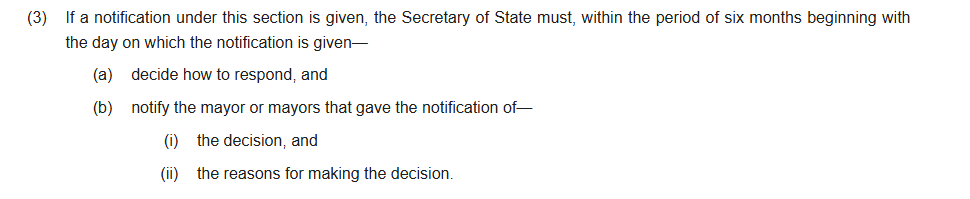
More transparency would be welcome and I think RtRs should function like a Written Statement, where an application is submitted and published somewhere appropriate. The Government doesn’t need to legislate again to introduce this transparency, it could simply decide to proceed in that fashion.
10. Create new Passenger Transport Executives England-wide?
London’s transport governance is centred on Transport for London (TfL), while six Passenger Transport Executives (PTEs) operate elsewhere in England, serving Greater Manchester, Merseyside, South Yorkshire, Tyne and Wear (only part of the North East CA, I believe), the West Midlands and West Yorkshire. These bodies provide dedicated executive capacity to plan, procure and manage transport services across functional economic geographies. However, they often pre-date the current devolution settlement and are available to only a minority of strategic authorities. The Government should therefore give all strategic authorities the power to establish statutory Passenger Transport Executives where a specialist transport delivery body would strengthen capability, support integrated transport networks and improve the delivery of mayoral transport priorities.
That’s another ten ideas in the Ideas Bank, folks. As ever, please send me your ideas and, if you enjoyed the article, please subscribe.