
Can — and should — mayors be allowed to offer tax rebates?
debates over tax rebates are about fiscal policy, but also the political differences that greater devolution will create — and what they mean for the relationship between Whitehall and authorities.

The Government published its Rewiring the State statement on Friday. For an overview, Jonathan Carr-West, the LGIU Team and I produced an on-the-day briefing.
I spent much of the weekend re-reading the statement alongside literature on collaborative governance for a project Groundwork is doing with City-REDI on trust and devolution.
Political scientists Chris Ansell and Alison Gash argue that collaborative governance develops through a "virtuous cycle of collaboration" in which participants focus on "small wins" that build trust, commitment and shared understanding. That framework provides an interesting lens through which to consider Friday's announcement. If even advocates of devolution respond to a radical transfer of powers with political opposition, what incentives does that create for central government, and what are the implications for the collaborative relationship between Whitehall and local government that devolution ultimately depends upon?
In my view, the statement represents a significant development in English devolution, arguably more substantive than either the Levelling Up White Paper or the English Devolution White Paper. The Centre for Cities agrees, describing it as the largest transfer of power “in the history of the state“. That such a package has been brought forward within two weeks of the new administration taking office is notable.
However, much of the immediate political reaction came from elected mayors who were critical of aspects of the announcement, and those responses dominated the headlines over the weekend.
Ahead of the statement, The Times reported that Lord Houchen wanted to use the income tax and business rates expected to be assigned to the Tees Valley Combined Authority to "create a new rebate scheme to put money back into people's pockets and let families keep more of the money they earn."
Houchen was not alone in signalling an interest in using devolved revenues to reduce tax burdens. Early responses broadly reflected different political priorities, with Conservative and Reform mayors reportedly expressing greater interest in tax reductions, while Labour mayors are generally expected to prioritise investment in infrastructure, housing and economic development. LBC presenter Lewis Goodall described this as "Labourism, done locally."
This illustrates an important feature of the politics of devolution. Advocates of devolution are not a homogeneous group, and greater autonomy is likely to expose, rather than diminish, ideological differences over how devolved powers should be exercised.
The debate over tax rebates reflects these wider differences. In principle, I believe mayors should have the autonomy to decide how devolved revenues are used, including whether to reduce taxes. But tax competition between places would mark a much more significant departure from the current devolution settlement than anything proposed to date, and it is not an issue that has been seriously considered in the context of English devolution. It is a medium-term opportunity rather than an immediate priority. Caution would be understandable given the Independent Review of Teesworks and the Best Value Notices issued to the West of England Combined Authority and the Cambridgeshire and Peterborough Combined Authority demonstrate there is still some capability-building required.
There is also a question about the mechanism through which a mayor could deliver a “tax rebate”, and whether the current framework allows one. Lord Houchen has suggested introducing a Business Rates Relief Scheme, although those schemes have traditionally been administered by local authorities.
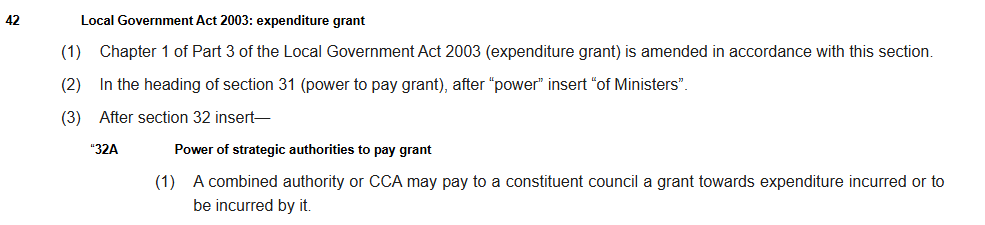
The answer is likely to depend on the form any rebate would take. Section 42 of the English Devolution and Community Empowerment Act enables a strategic authority to make grants to constituent local authorities only “towards expenditure”. On the face of it, that provision does not appear to permit a strategic authority simply to transfer funding on the condition that, for example, a constituent authority reduces council tax or provides an equivalent rebate.
The Government, I think, shares the same view. When asked whether a tax rebate is possible, Louise Haigh told Radio 4 that “at the moment that is not how it works … there is not a system that would currently allow that … but we will consider proposals that are put forward”.
It’ll be interesting to see how the debate evolves.