
#5 Do we need more accountability in local government?
It may not be fashionable to say so, but accountability plays a vital role in driving performance. We should welcome them — not resist them.

There is a long tradition of accountability in English local government. The Municipal Corporations Act 1835 was radical for its time, creating elected local authorities responsible for multiple services across a defined geography. Before that, local institutions were largely unelected and single-purpose.
From the outset, these new authorities were held accountable. They were required to meet in public and to have their accounts audited — two principles that still underpin local governance nearly 200 years later.
Over time, accountability has expanded and evolved.
A potted history might point to the Local Government Act 1974, which established a formal complaints architecture, including the Local Government and Social Care Ombudsman, now a central pillar in addressing maladministration. It also formalised the role of the Section 151 Officer, including the power to issue a Section 114 notice — effectively the ability to declare a council ‘bankrupt’.
The Local Government and Housing Act 1989 put the Monitoring Officer on a statutory footing, responsible for ensuring legal compliance and sound governance.
Then came the Freedom of Information Act 2000 — a landmark reform that, despite ongoing frustration within the sector, has reshaped transparency. Many authorities privately think it should be revised, as does the Government, reportedly.
In the same year, the Local Government Act 2000 was introduced, requiring authorities to establish Overview and Scrutiny Committees and introducing a mandatory Code of Conduct for councillors.
During the Coalition period the Accounts and Audit Regulations 2015 effectively embedded Audit and Risk Committees as a core feature of governance.
Today, once it receives Royal Assent, The English Devolution and Community Empowerment Bill will add to that. It has created a Local Audit Office and the Government has published a Local Outcomes Framework (which was originally intended to be called the Local Government Outcomes Framework but local authorities, not unreasonably, pointed out that the outcomes were not solely within their control).
Authorities are right to be concerned that there is already enough accountability and more would be a mistake. The sector does not need more accountability. But it does need better accountability.
For too long, accountability in local government has been dominated by conformance — rules, processes, and compliance. That does not always drive performance.
Academic literature has long made this distinction. Accountability has “chameleon”-like features: it adapts to the purposes it is made to serve.
It can be top-down (from central government), bottom-up (from local authorities to central government, for example), or sideways or ‘outward’ (through the public, notably elections).
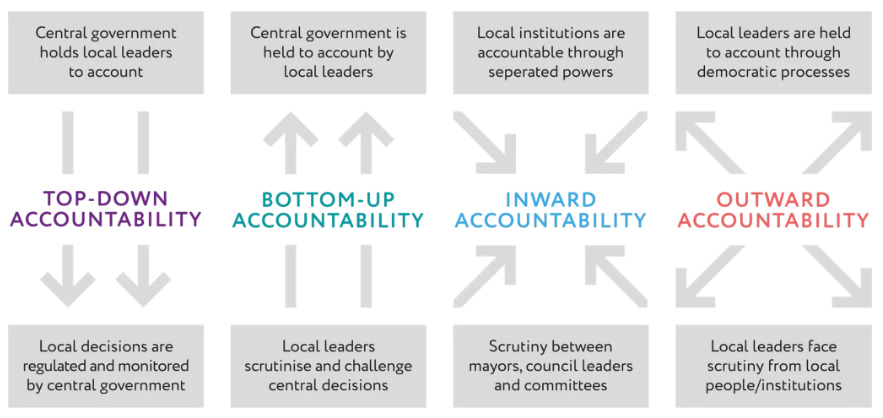
Source: Bennett School for Public Policy
The “long route” to accountability — where citizens directly scrutinise and exert pressure on decision-makers — can improve service delivery. But we rarely seem to discuss the relationship between different types of accountability. I wonder, for example, if we need more top down accountability - such as requirements on authorities to collect, share or publish information - in order to facilitate bottom-up accountability, or to support the public to scrutinise their local institutions?
There are, of course, limits. As Mark Bovens have argued, more controls do not automatically lead to better governance. Excessive monitoring can slow decision-making and damage operational effectiveness.
But it is striking how little we still know about local government performance. Lets take some examples. We do not even have an accurate record of how many potholes England’s authorities fill. And though authorities collect that information, they use different methodologies to determine the number of potholes they’ve filled in, so collecting the data does not shed light on ‘pothole performance’. If the goalposts are different between authorities, it makes it harder to hold them to account.
In another example, we do not know where the tens of thousands of households placed in temporary accommodation outside of their borough are placed. I am grateful that MHCLG has now agreed to provide regional figures on the issue, but that doesn’t provide a full picture. Why does that matter? Well, we do not understand the distortionary impact of homelessness on local housing supply, for example.
The other issue is that while many of the public service challenges the sector faces can be traced back to government policy or funding, or a lack of it, different approaches to service delivery is creating significantly different outcomes, which poor data and weak public accountability make it difficult to expose.
So my plea is this. Accountability is important and we need a much more robust accountability architecture. There is a lack of consistency across authorities in the collection and publication of data. Authorities provide the Government with an awful lot already, but there are some quite significant gaps. And - much like the Office for Local Government tried to do - the Government should create a one-stop-shop of service performance, across authorities. With that, we can take a more structured approach to identifying poor performance. Without comparable, accessible data, neither the public nor policymakers can properly scrutinise performance or hold authorities to account.
At risk of focusing too much on transparency, rather than accountability, I have not made the csse that more accountability is neatly related to improved outcomes or that it 'magically' happens. But I do argue that it is helpful or even a necessary pre-condition for better policy-making and that does improve outcomes (some of the meta analyses in the articles I link to make a similar case for it, from memory).
Any increase in accountability has to be balanced against ensuring it does not lead to bureaucratic paralysis.
The sheer weight of complaints handling and requests for information has hardly improved service delivery across the sector. If anything it consumes disproportionate resources without really satisfying the customer.